

How WappCloud Helps D2C Brands Keep Customers Coming Back

Written by
WappCloud Team

Post date
05 June 2026
Most D2C founders I talk to are obsessed with their acquisition numbers. Cost per click, ROAS, conversion rate — it's all tracked religiously. And honestly, that makes sense. Acquisition is what gets the flywheel spinning.
But here's the thing nobody talks about enough: retention is what keeps it spinning.
If you're constantly bringing new customers in through the front door while they quietly leave through the back, you're running a business that needs to work harder than it should. And in today's market, that's expensive.
At WappCloud, we work with D2C brands who've figured this out. They're not just using WhatsApp to send order updates. They're using it to build relationships — and those relationships are translating directly into repeat revenue.
Let me walk you through how that actually works.
Retention Is Where the Real Money Is
There's a stat from Harvard Business Review that gets shared a lot in marketing circles: acquiring a new customer costs 5 to 25 times more than retaining an existing one. I've seen this play out in actual brand economics too.
Think about it from a unit economics angle. If you spend ₹800 to acquire a customer who buys once and disappears, that ₹800 lives entirely inside one transaction. But if that same customer comes back two more times? Suddenly your acquisition cost is spread across three purchases. Your effective CAC just dropped, without spending a single extra rupee on ads.
That's not a marketing tactic. That's a structural advantage.
The brands that scale well aren't just better at acquisition. They're better at keeping the customers they already paid to bring in. And increasingly, WhatsApp is the channel they're using to do it.
Why WhatsApp Works Differently for Retention
Email open rates in e-commerce hover around 20% on a good day. SMS can feel intrusive. Push notifications get ignored or disabled. But WhatsApp? It's where people actually talk to each other.
That changes the dynamic completely.
When a brand reaches out on WhatsApp, it lands in the same place as a message from a friend or family member. That's not something to take lightly — or abuse. But when it's done right, with the right message at the right time, it doesn't feel like marketing. It feels like service.
That's the distinction WappCloud helps brands make. Not just blasting messages through a new channel, but designing a post-purchase experience that actually feels good to be on the receiving end of.
What a Real Retention Journey Looks Like
Retention doesn't happen from one message. It's a sequence of touchpoints that, together, make a customer feel seen and valued. Here's how we typically help D2C brands structure it:
1. Start with Feedback, Not a Follow-Up Sale
The first message after delivery shouldn't be pushing the next purchase. It should be asking how the first one went.
This is something a lot of brands skip because it doesn't feel like it drives revenue directly. But it does — just not in an obvious way. Feedback messages do two things: they show the customer you care about their experience, and they create segmentation you can actually act on.
"How's the product working out for you? We'd love to know."
If someone had a great experience, that's your cue to introduce a referral nudge or a complementary product. If someone had a problem, that's your cue to resolve it before you lose them permanently. WappCloud's flows handle both paths automatically, so no customer falls through the cracks.
2. Help Them Get the Most Out of What They Bought
This one matters more than people realize, especially in categories like skincare, supplements, fitness, or electronics.
When someone buys a product, they often have quiet questions they don't voice. Am I using this right? How long before I see results? Should I be doing anything differently? Those unanswered questions create doubt, and doubt makes people hesitant to buy again.
A simple follow-up three to five days after delivery — usage tips, a quick FAQ, a video tutorial — removes that friction. It's not about being helpful for the sake of being helpful. It's about building the confidence that leads to a second purchase.
3. Time Your Replenishment Messages Properly
For consumable products — groceries, skincare, supplements, pet food — repeat purchase is already built into the product's nature. The customer is going to run out. The question is just whether they come back to you or go somewhere else.
The answer usually comes down to timing and convenience. If you reach out right when they're running low, in a friendly way that makes reordering easy, they rarely go elsewhere. If you reach out too early or too late, or with a generic broadcast, you've lost the moment.
WappCloud lets brands set replenishment triggers based on actual product lifecycles. A 30-day supplement gets a reminder on day 25. A 60-day skincare kit gets one around day 50. The message feels relevant because it is relevant.
"Running low? Restock in two taps and never miss a day."
That kind of timing isn't magic. It's just structure — and WappCloud makes it straightforward to set up.
4. Stay Relevant Between Purchases
One of the biggest mistakes D2C brands make is going silent between purchase cycles and then showing up only when they want something.
People see through that. And over time, it trains them to tune out your messages entirely.
The brands that retain well stay in touch with value — not promotions. Care tips. Product pairings. Use cases they might not have thought of. Customer stories. Content that makes the customer feel like the brand is genuinely invested in their experience.
These messages don't push a sale. But they keep the brand warm, so when the time comes to reorder, you're the obvious choice rather than a distant memory.
5. Build the Full Journey, Not Just the Messages
The problem with most retention efforts isn't that the individual messages are bad. It's that they're inconsistent. A broadcast here. A festive offer there. A manual reminder when someone remembers.
That's activity. It's not a strategy.
WappCloud helps brands map the full post-purchase journey so every touchpoint connects to the next:
- Day 1 — Order confirmation with delivery timeline
- Day 3–5 — Usage guidance and quick-start tips
- Mid-cycle — Value-led content (care tips, best practices, pairing suggestions)
- Pre-replenishment — Timely refill reminder with easy reorder link
- Post-repeat purchase — Appreciation message and loyalty reinforcement
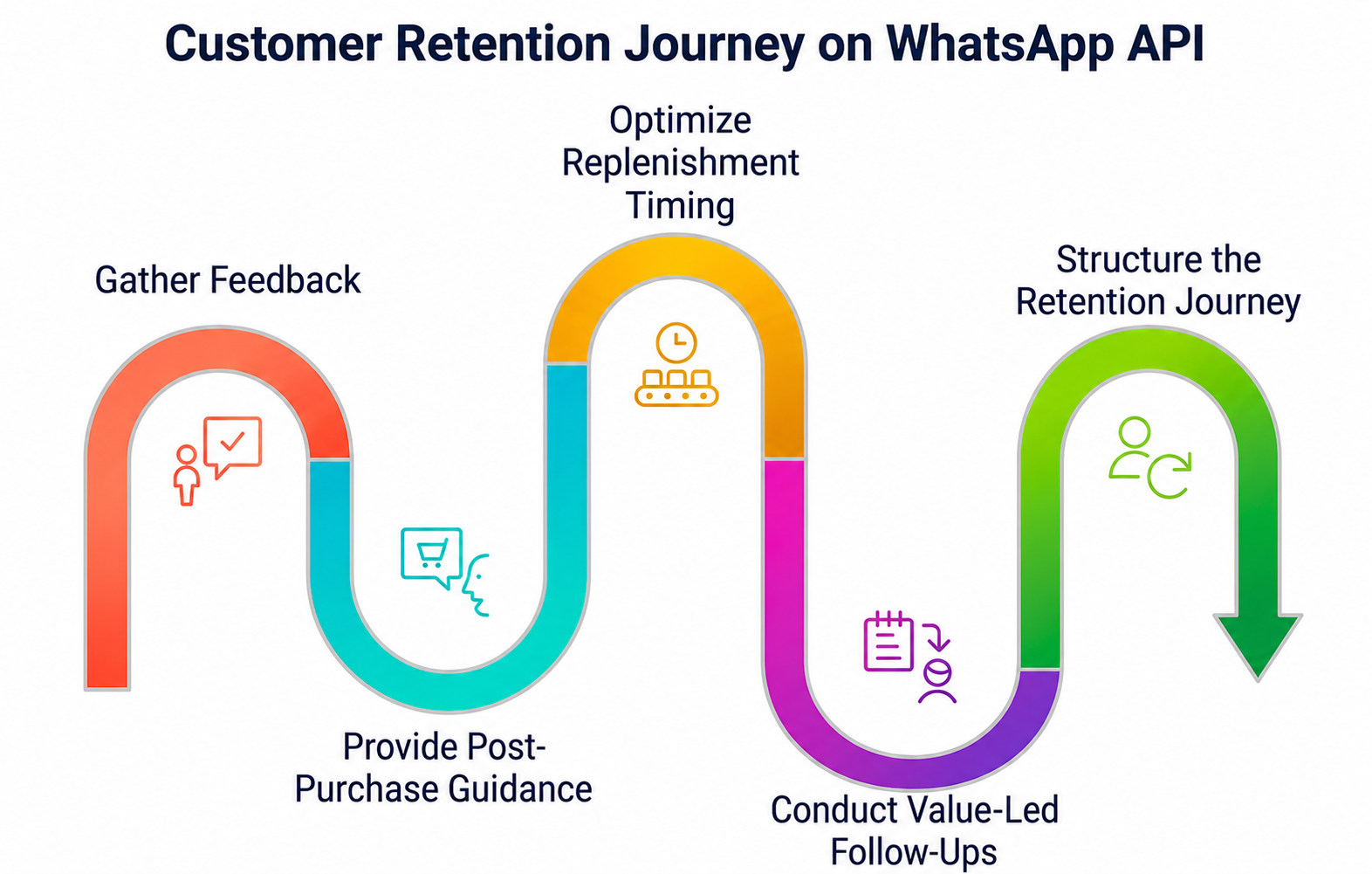
When this is automated and running properly, it stops feeling like marketing and starts feeling like a relationship. And relationships are what drive lifetime value.
The Bigger Picture: What Retention Does for a Brand
Beyond the revenue math, retention shapes how a brand is perceived.
A brand that checks in thoughtfully after a purchase feels premium — even if the product itself is mid-range. A brand that disappears after payment feels transactional. Over time, that difference compounds into something meaningful: higher LTV, stronger word-of-mouth, lower dependence on paid acquisition, and more predictable growth.
Buyers don't always remember the ad that brought them in. They remember how the experience felt after they pressed buy. That's where most D2C brands are leaving money on the table, and it's exactly where WappCloud is designed to help.
Ready to Build a Retention System That Actually Works?
If your repeat purchase rate isn't where you want it to be, the answer probably isn't more ads. It's a better post-purchase experience.
WappCloud helps D2C brands design and automate WhatsApp-based retention journeys that feel personal, not automated — even when they're running entirely on their own.
If you want to see what that looks like for your category, our team is happy to walk you through it. Visit www.wappcloud.com for more details and book a demo to experience WappCloud.