

How to Use WhatsApp to Collect More Customer Reviews

Written by
WappCloud Team

Post date
17 July 2026
Winning a customer is only half the outcome that matters. Getting that customer to publicly vouch for the experience, through a rating or a short piece of feedback, is what compounds into the next set of customers. Yet most businesses still request reviews the way they did a decade ago: a generic email sent days after purchase, competing for attention in an already crowded inbox.
This is worth solving properly. A structured approach to review collection is not a minor operational detail, it is a measurable growth lever, particularly for businesses where local visibility and social proof directly influence purchase decisions.
The channel matters as much as the message. Businesses that continue relying on email or SMS for this task are, in effect, competing for attention in the least attentive parts of a customer's day, while a far more responsive channel sits largely underused for this specific purpose.
Why Reviews Matter More Than Ever
Reviews have become one of the strongest drivers of purchase decisions, whether a customer is booking an appointment, choosing a service provider, or comparing products. A steady stream of recent, genuine reviews builds a level of trust that marketing copy alone cannot replicate, and review volume and rating quality increasingly influence how visible a business is in local search results.
Why Most Review Requests Go Unanswered
Email and SMS remain the default channels for requesting feedback, and both suffer from the same limitation: low visibility. Effective review collection depends on three factors working together: the right channel, the right timing, and a request simple enough that responding takes less effort than ignoring it.
1. Use the Channel Customers Actually Check
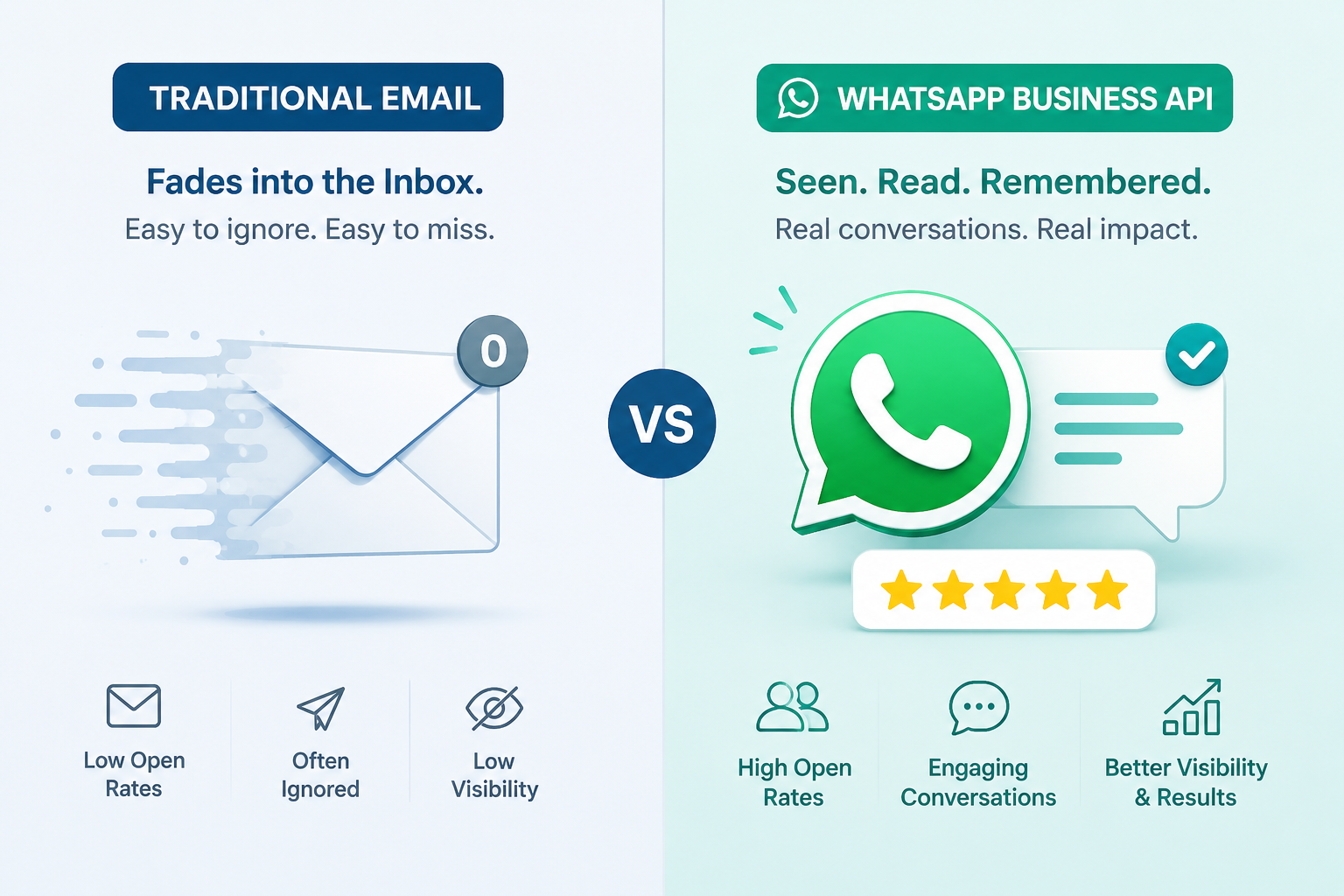
WhatsApp messages are typically opened within minutes, with open rates commonly reported between 90% and 98%, compared to roughly 20% for email. Response rates follow a similar pattern, with WhatsApp review requests seeing response rates in the 20% to 35% range, against 5% to 10% for email. The difference comes down to context: a WhatsApp message reads as a direct, personal request rather than a marketing send.
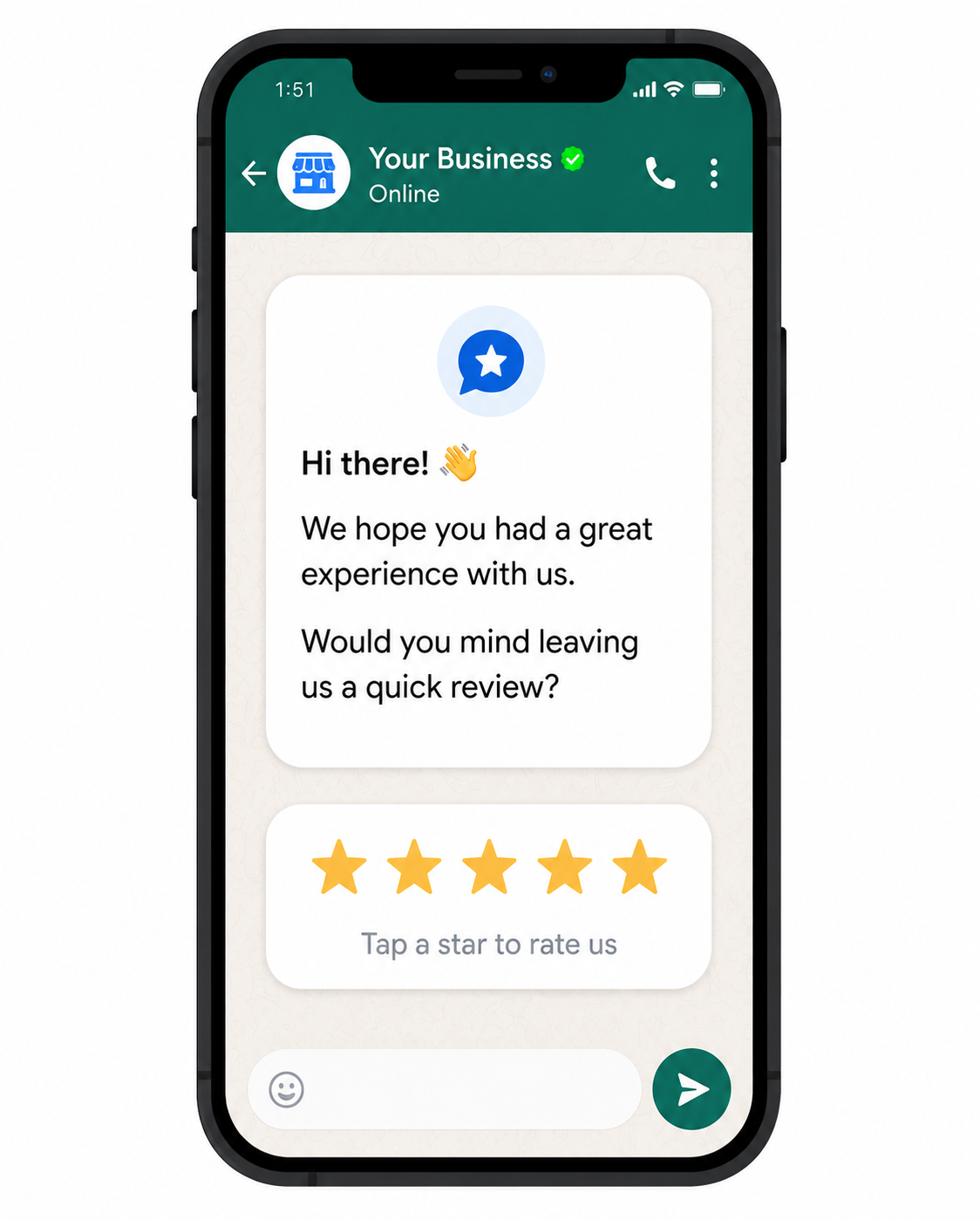
"Hi [Name], thank you for your recent order with [Business Name]. We'd appreciate 30 seconds of your time to rate your experience. [Review Link]"
Platforms like WappCloud allow businesses to trigger this request automatically the moment an order is marked delivered or a service is completed, removing the dependency on manual follow-up.
2. Time the Request Around the Moment of Satisfaction
Timing meaningfully affects response quality. Requesting feedback too early produces vague responses; waiting too long means the experience has faded. A practical approach is to send the initial request a few days after delivery or immediately after service completion, followed by a single, measured reminder about a week later if there is no response. Repeated requests reduce goodwill and increase opt-outs.
3. Reduce Friction to the Minimum
Every additional step between the request and the submitted review lowers completion rates. Linking directly to a review page rather than a homepage, using a simple one-to-five rating with an optional comment, and keeping the message concise all measurably improve response rates.
4. Manage Negative Feedback Proactively
Not every response will be positive, and that is valuable input rather than a risk to suppress. Routing any low rating to a private, responsive conversation before it becomes a public review allows a business to resolve the issue directly and, in many cases, retain the customer.
5. Apply Incentives Within Policy
Incentivizing feedback can improve response rates, provided the incentive applies to any honest review rather than being conditional on a positive rating. Most platforms, including WhatsApp's own commercial guidelines, prohibit rewards tied specifically to favorable outcomes.
6. Convert Reviews Into Reusable Assets
With explicit permission, positive reviews can be repurposed as testimonials across a company's website and social channels, extending the value of a single piece of feedback well beyond its original context.
Who This Works Well For
- Clinics and service providers sending a review link immediately after an appointment
- E-commerce and delivery businesses triggering requests a few days after an order arrives
- Hospitality and local businesses building a steady stream of fresh, recent reviews
In each case, the request is tied to a specific, recent moment of engagement, not a generic periodic blast, which is precisely what drives the response-rate difference discussed above.
WhatsApp vs Email for Review Collection
| Email Review Requests | WhatsApp Review Requests | |
|---|---|---|
| Open rate | Around 20% on average | Around 90–98% within minutes |
| Response rate | Roughly 5–10% | Roughly 20–35% |
| Feel | Formal, easy to ignore | Personal, direct, hard to miss |
| Steps to submit | Open email, click link, load page | Tap once, follow a pre-filled link |
| Best for | Long-form surveys, formal records | Quick star ratings & short feedback |
| Follow-up | Often unread on resend | Can be automated without feeling spammy, if paced well |
Metrics Worth Tracking
- Response rate: the share of requests that receive any reply
- Average rating trend: whether recent scores are improving, stable, or slipping
- Time to review: how long after the triggering event customers respond
- Negative feedback resolution rate: how many low ratings are addressed before becoming public
- Testimonial conversion: how many positive reviews are successfully repurposed as marketing content
Tracking these consistently turns review collection from a one-off campaign into an ongoing feedback loop that informs both customer experience and marketing strategy.
Where Automation Comes In
Manual outreach is manageable at low volume, but it does not scale. Automating review requests through trigger-based workflows, tied to events such as an order being delivered or a support ticket being resolved, ensures consistency without adding operational burden to a growing team.
Consistency, more than any single clever message, is what separates businesses with a steady stream of fresh reviews from those with a handful of outdated ones. A well-timed, well-automated system does the asking every time, so the team can focus on the relationships those reviews are built on.
This is where a WhatsApp Business API platform like WappCloud fits in, handling the timing, segmentation, and delivery of review requests so teams can focus on the responses rather than the process of asking.
Give customers an easy way to be heard, and they will tell you, and everyone else, exactly what they think of you.
Ready to turn more of your customers into public advocates? Discover how WappCloud can help you automate review collection and build lasting customer relationships.